
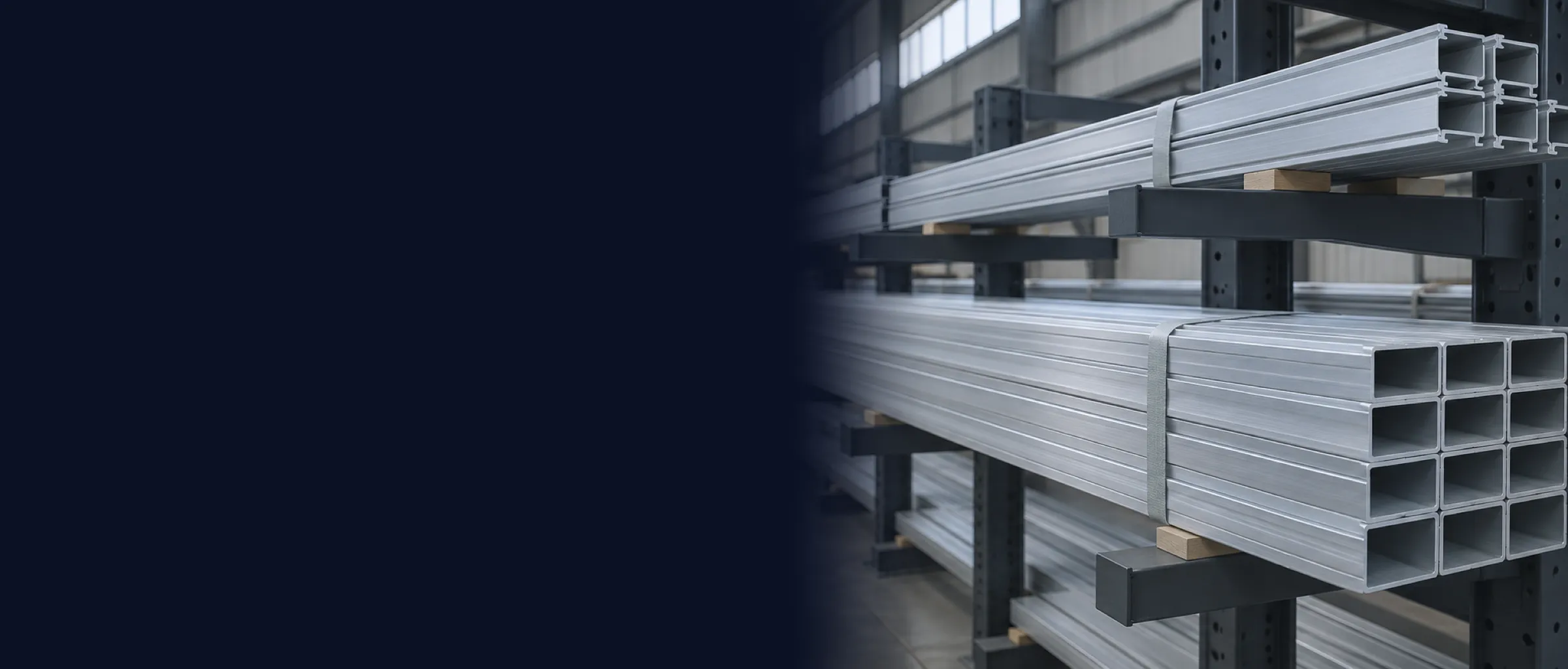
Korean aluminum extrusions for international buyers
Standard and custom-die profiles, tube, bar and rod from qualified Korean extruders, produced to the buyer's drawing and specification, with one counterparty managing the extruder, the die, the documents and the shipment.
What Korean extruders make, and for whom
A broad extrusion industry serving construction, transport, electronics and industrial equipment, working mainly in 6xxx alloys.
Korea has a broad aluminum extrusion industry: larger producers with their own billet casting, and many small and mid-size press shops. They supply construction, automotive and rail, electronics, solar and industrial equipment makers, and most of their output is in the 6xxx alloy series.
Extruders do not smelt aluminum. They buy billet, or cast it from primary metal and scrap, heat it, and push it through a steel die to make a profile of constant cross-section. The profile is then cooled, stretched straight, cut and aged to its final temper.
Inquivix Technologies sources extrusions from qualified Korean extruders for international buyers who have a drawing and a specification and want one counterparty managing the extruder, the die, the qualification, the documents and the shipment. We do not extrude aluminum and we do not hold stock. Every order is produced to the buyer's drawing.
We also supply extrusion billet into Korea. That side of the business is on the primary metal page.
Products: profiles, tube, bar and rod
Named by cross-section. State the product form in the specification, because the standard and the tolerances follow from it.
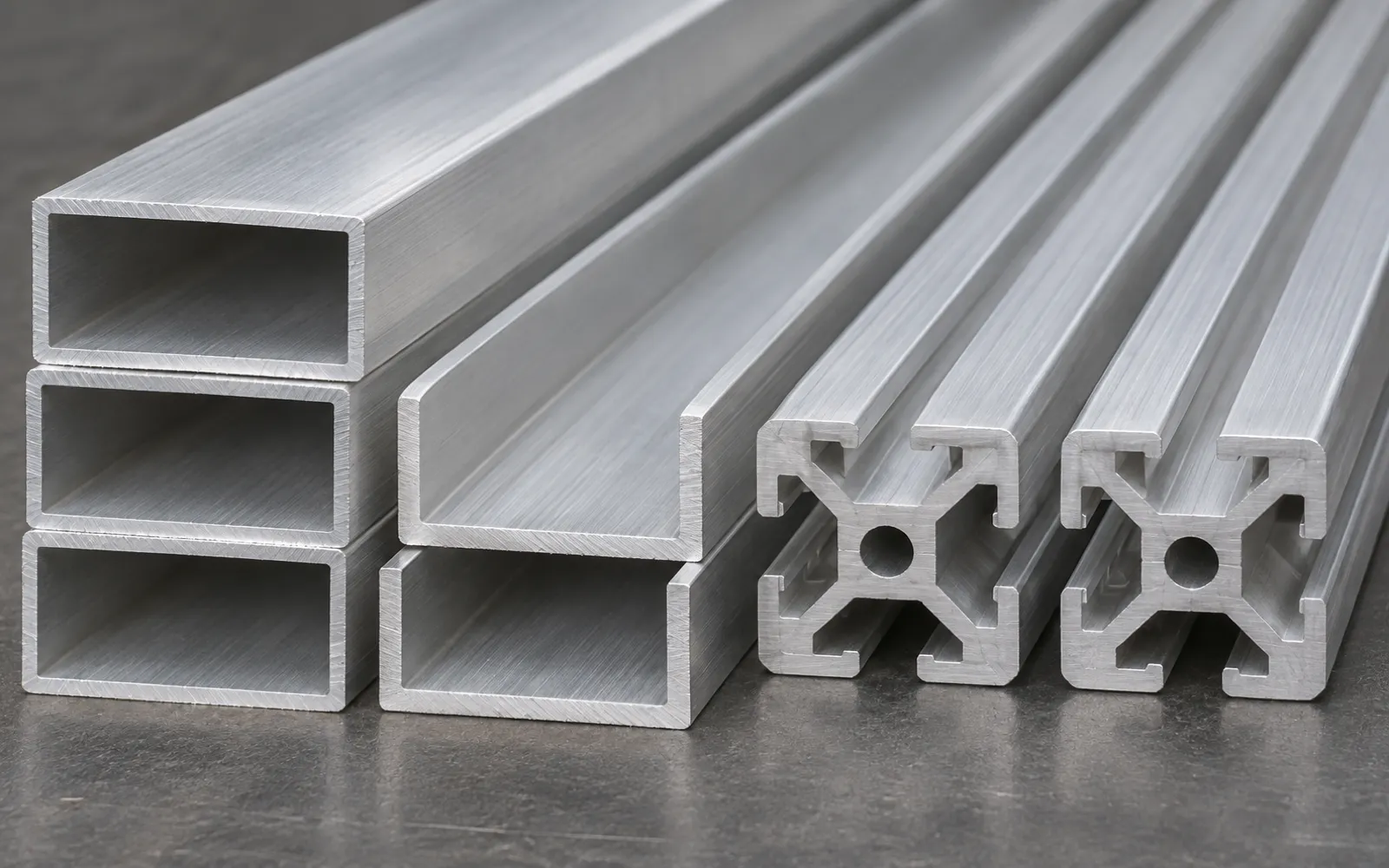
- Standard profiles. Angles, channels, tees, flat bar, square and rectangular hollow sections and other catalogue shapes that an extruder already holds dies for. No die charge, and usually the shortest route to a first order.
- Custom profiles. A section made to the buyer's drawing, from a die cut for that profile. Solid, semi-hollow and hollow sections are all possible. See dies and drawings below.
- Tube. Round, square and rectangular tube. Most structural tube is extruded through a porthole die, which leaves longitudinal weld seams in the wall. Seamless tube is a separate product, made by a different method, and must be asked for by name.
- Bar and rod. Round, square, flat and hexagonal solid sections, supplied in straight lengths for machining or fabrication.
Extrusions are supplied in straight lengths. State the length and whether it is a stock length for the buyer to cut or a finished length with a tolerance.
Alloys and tempers
Most extrusions are 6xxx alloys. The temper decides the strength, so name both.
| Alloy | What it is used for |
|---|---|
| 6063, 6060 | The general and architectural extrusion alloys. Good surface finish, anodize well, easy to extrude into thin and complex sections. Windows, doors, curtain wall, frames, trim, heat sinks. |
| 6061 | The structural alloy. Stronger than 6063, weldable and machinable. Machine frames, transport structures, fixtures, load-bearing parts. |
| 6005A, 6082 | Structural alloys for larger and heavier sections. Rail and vehicle structures, platforms, load-bearing profiles. |
| 6101 | The electrical conductor alloy. Busbar and conductor sections. |
| 1xxx, 3xxx | Soft alloys for tube and simple sections where formability or conductivity matters more than strength. |
| 7xxx | High-strength alloys. Extruded by fewer plants and reviewed per inquiry. |
The usual tempers are T5 (cooled from the press and artificially aged) and T6 (solution heat-treated and artificially aged). T6 is stronger than T5 in the same alloy. T4 (solution heat-treated and naturally aged) is supplied where the buyer forms the part and ages it afterwards. Write the alloy and temper together, for example 6063-T5 or 6061-T6.
Composition limits for 6061 and 6063 are on the alloy reference page.
Dies and drawings
A custom profile needs its own die. The drawing decides whether the profile can be extruded, on which press, and at what cost.
A custom profile starts with the buyer's cross-section drawing. The extruder reviews it before quoting: the overall size of the section, the wall thicknesses, the balance of the shape, any hollows, and which surfaces are visible in use. Small changes at this stage, such as a more even wall or a larger corner radius, often make a profile easier to extrude and more consistent, and we pass the extruder's comments back to the buyer before the die is cut.
The die is made for that one profile. The die charge is a one-time cost stated in the quotation, together with the terms on which the die is held and who may use it. After the die is made, the extruder runs first samples for the buyer to measure and approve before production starts.
The size of the section and its weight per metre decide which presses can run it, so capability differs from one extruder to another. We confirm it for each drawing and do not publish a general size table.
Tolerances
Standard tolerances come from the standard the order names. Anything tighter goes on the drawing.
Each extrusion standard sets tolerances on cross-section dimensions, wall thickness, straightness, twist and length. If the order names a standard and nothing else, those tolerances apply.
Where a dimension matters more than the standard allows, for example a slot that takes a mating part, mark it on the drawing with its own tolerance. The extruder confirms whether it can be held before the die is cut. Tight tolerances on a few named dimensions are normal. Tight tolerances on every dimension raise cost and scrap, and are worth questioning.
Finishing and cutting
Mill finish is the base. Anodizing, powder coating and cutting to length are done on request.
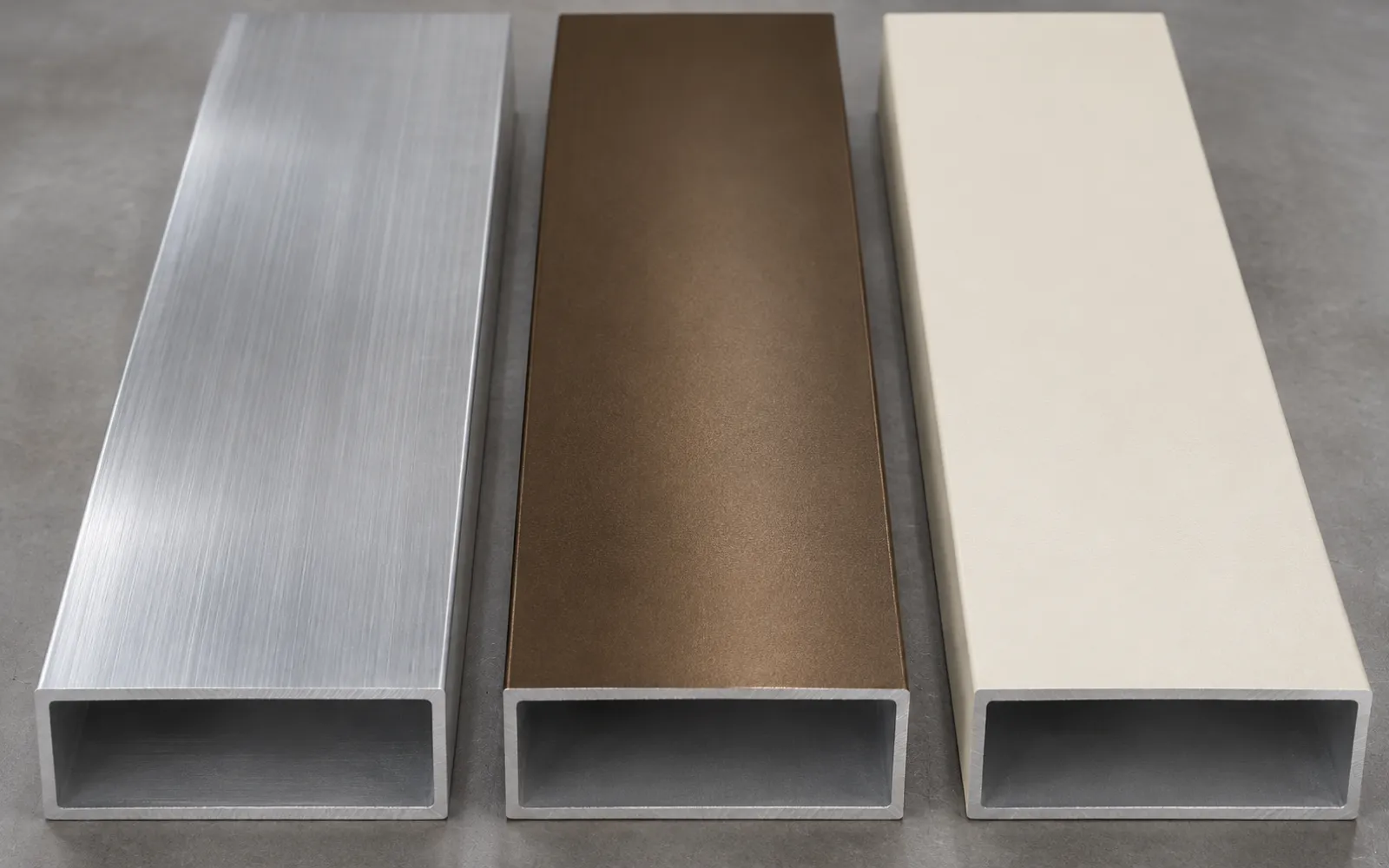
- Mill finish. As extruded, with light die lines. Suitable for hidden or structural parts and for parts the buyer will finish.
- Anodizing. State the film thickness class, for example AA10, AA15 or AA20 under ISO 7599, and the colour. Thicker classes are specified for outdoor exposure.
- Powder coating. State the colour and the coating specification the project calls for.
- Cut to length. Finished lengths with a stated tolerance, packed for the buyer's line.
Tell us which faces are visible in use. The extruder then runs, racks and packs the profile to protect those faces. Further machining, such as drilling or milling, is reviewed per inquiry.
Standards
Korean extruders work to KS by default. ASTM, EN and JIS on request. Name the standard at inquiry.
Korean extruders work to the Korean Industrial Standards (KS) by default. The extruded shapes standard is KS D 6759, with KS D 6761 for seamless tube and KS D 6763 for bar and wire. They are closely aligned with the corresponding JIS standards. On request, and routinely for export, extruders certify to:
- ASTM B221 for extruded bar, rod, profiles and tube
- EN 755 for extruded rod, bar, tube and profiles, with EN 12020 for precision profiles in 6060 and 6063 and chemical composition to EN 573
- JIS H 4100 for extruded shapes, JIS H 4080 for tube and JIS H 4040 for bar and wire
The test certificate states the standard tested against, the alloy and temper, the chemical analysis of the cast and the mechanical test results for the lot. A certificate issued to KS cannot be converted to ASTM after the fact.
Applications
Where extruded sections from Korea are used.
- Building and construction. Window, door and curtain wall sections, structural framing, railings and trim.
- Transport. Structural members and enclosures for vehicles, rail and trailers.
- Solar and energy. Module frames and mounting structures, busbar and conductor sections.
- Industrial equipment. Machine and equipment frames, conveyor and automation profiles, guarding.
- Electronics and thermal. Heat sinks, housings and chassis sections.
The application decides the alloy, the temper, the tolerance level and the finish. State it at inquiry, because it also decides which extruders are the right ones to quote.
US and EU trade rules for extrusions
Extrusions fall under the same US and EU measures as other aluminum products. Check them before pricing an order.
United States. Extruded profiles, bar, rod and tube are aluminum articles under Section 232. The current rate and how it is calculated are on the compliance page. In October 2024 the US International Trade Commission found that imports of aluminum extrusions from 14 countries, Korea among them, did not injure the US industry, so no antidumping or countervailing duty order was issued on Korean extrusions. Confirm the position again before a US order is priced.
European Union. Extruded profiles, bar, rod and tube are goods covered by the Carbon Border Adjustment Mechanism. The EU importer needs emissions data for the extrusion and for the billet it was made from. What is available differs by extruder and is confirmed at inquiry.
How to specify an order
A complete specification lets the extruder quote without a second round of questions and lets us match the inquiry to the right extruder the first time.
Drawing
The cross-section with dimensions and tolerances, as a PDF and a CAD file. For a standard shape, the shape and its dimensions.
Alloy and temper
For example 6063-T5, 6061-T6.
Standard
KS, ASTM, EN or JIS for chemistry, mechanical properties and tolerances.
Length
Stock length or finished length, with the tolerance.
Finish
Mill finish, anodized (class and colour) or powder coated (colour and specification), and which faces are visible.
Quantity
Per profile for the order, and expected annual volume, which affects which extruders will quote.
Application
Decides the tolerance level and the extruders suited to the work.
Packing
Interleaving, bundle size and weight, and any pallet requirement at the destination.
Destination and Incoterm
Decides documentation and, for the US and EU, the treatment on the compliance page.
Required delivery date
A custom profile adds die making and sample approval before the first production lot. We state the lead time for each stage in every quotation.
Frequently asked questions
Can I order from an existing die?
Yes, for standard shapes an extruder already holds dies for. We check which extruder has the shape and size and quote from that die. There is no die charge.
Who owns a custom die?
The quotation states it. The usual arrangement is that the buyer pays a one-time die charge and the die is used only for that buyer's orders. Confirm the terms before the die is ordered.
Can I approve samples before production?
Yes. For a custom profile the extruder runs first samples from the new die, and production starts after the buyer approves them.
Can you supply anodized or powder-coated profiles?
Yes, on request. State the anodizing class and colour or the coating specification and colour at inquiry.
Are there US antidumping duties on Korean extrusions?
No order is in place: the US International Trade Commission made a negative determination in October 2024. Section 232 tariffs do apply. See the compliance page and confirm the position before pricing.
What is the minimum order?
It depends on the extruder, the profile and the finish. We confirm it with the quotation.

Have a specification or a sourcing question? Tell us the product, alloy, quantity, and direction.